September 2026
Licensing a Molecule from China? What U.S. Biotechs Need to Evaluate First
Acquiring rights to an innovative asset is only the beginning. Here are the CMC, regulatory, and operational considerations that can determine how smoothly it moves into U.S. and EU development.
Verta Life Sciences
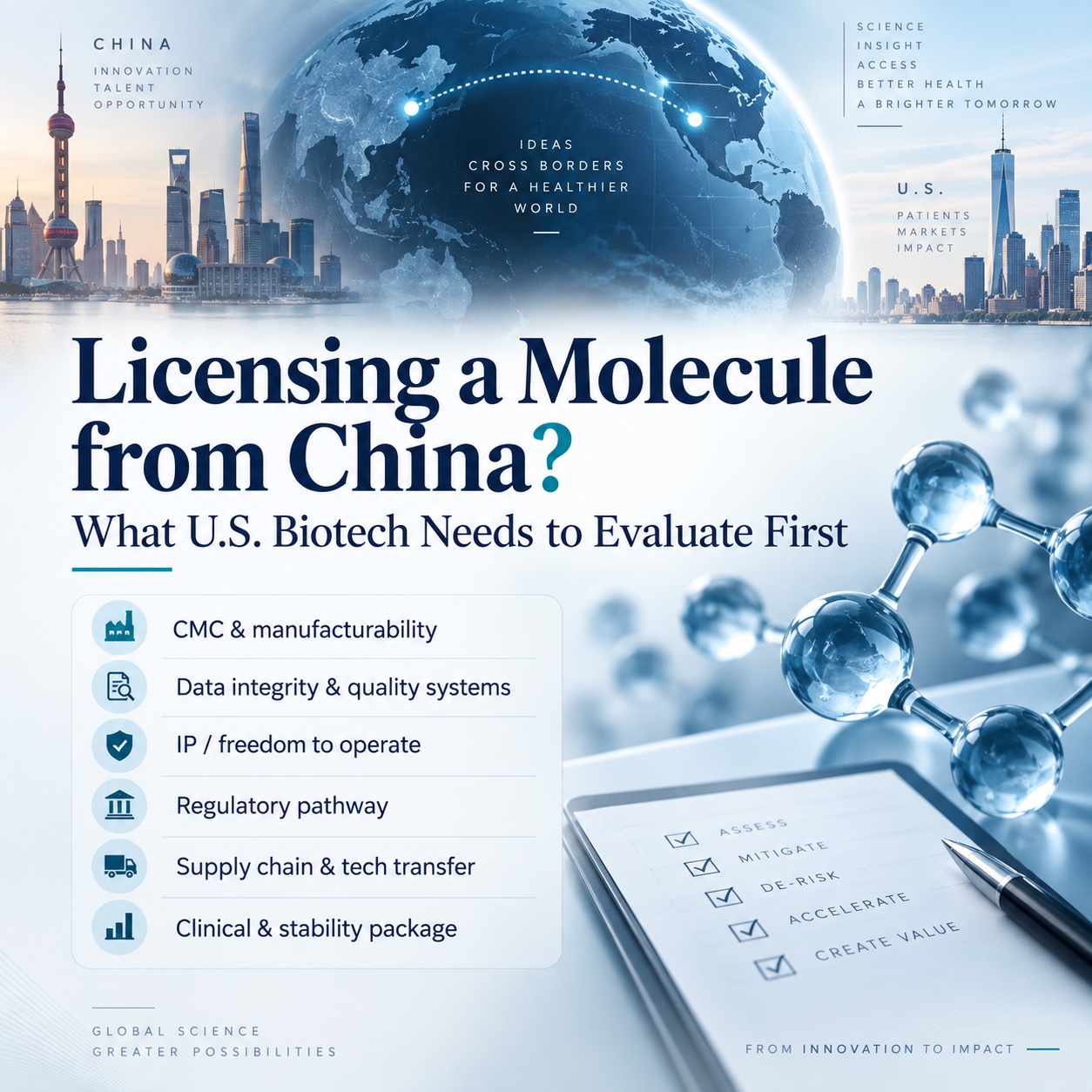
A Fast-Growing Deal Trend
Over the past few years, U.S. biotech and pharmaceutical companies have increasingly turned to China as a source of innovative drug candidates. China’s biotech sector has matured quickly, producing a deep and growing pipeline of novel therapeutics across oncology, immunology, metabolic disease, and beyond, often developed faster and at lower cost than comparable Western programs. For U.S. companies looking to fill pipeline gaps or gain access to new modalities, in-licensing these assets has become an increasingly common strategy.
These deals typically take the form of an ex-China license: the Chinese originator retains rights to develop and sell the molecule within China, while the U.S. partner acquires rights to develop and commercialize it in the U.S., EU, and other global markets. The appeal is clearly promising science, earlier-stage assets, and often more favorable deal economics than domestic alternatives.
The Catch: A Molecule Isn’t Clinic-Ready on Arrival
Acquiring the rights to a molecule is only the first step. Before it can enter a U.S. or EU clinical trial, its development history must meet FDA and EMA expectations, and that’s where many deals hit friction. Chinese manufacturing and data practices, while often scientifically sound, don’t always map cleanly onto Western regulatory documentation standards. Closing that gap is typically the single biggest driver of timeline and cost in these transactions.
Why CMC Due Diligence Comes First
Chemistry, Manufacturing, and Controls (CMC) due diligence is the foundation of any acquisition of this kind. It involves a close evaluation of cell line development, manufacturing processes, analytical methods, stability data, and the supply chain behind the molecule. The goal is to surface risks and data gaps early, before they become costly surprises during an FDA or EMA review, and to scope out exactly what additional work, if any, is needed before the asset can move into clinical development in a new market.
Determine Whether the Documentation Is Submission-Ready
Once diligence identifies what data exists and what’s missing, that information must be translated into the format regulators expect. For CMC, that means authoring Module 3 of the Common Technical Document and an Overall Quality Summary (OQS) for inclusion in an IND (U.S.) or IMPD (EU) submission. This isn’t simply repackaging data generated under Chinese practices; it often needs reformatting, supplementation, or re-analysis to align with FDA and EMA expectations.
From Documentation to the Clinic
Regulatory clearance to begin a trial is necessary but not sufficient; the physical supply chain has to be ready too. That means transferring the manufacturing and packaging technology needed for clinical trial materials, and establishing a reliable supply of investigational product for sites in the U.S. and EU. Without this operational layer, even a well-documented molecule can stall before it reaches a single patient.
Plan Technology Transfer and Clinical Supply Early
Regulatory documentation is only one piece of the transition.
Teams may also need to transfer processes or materials, establish clinical packaging capabilities, and ensure the investigational product can be supplied reliably for clinical trials in the U.S. and EU.
Addressing these questions early can help prevent an attractive licensing opportunity from becoming a difficult development program later.
Cross-Border Expertise Matters
Beyond the science and the paperwork, these deals require someone who can operate fluently on both sides, understanding Chinese manufacturing and quality practices as well as U.S. and EU regulatory expectations, and communicating across the language and cultural gap between originator and licensee teams. That bridge is often what determines whether a promising molecule reaches the clinic on schedule.
Having teams that understand both sides of that transition can make the handoff significantly more efficient.
How Verta Can Help
Verta has supported four U.S.–China molecule acquisitions over the past year, helping clients navigate exactly this path from CMC due diligence to Module 3 and OQS authoring for IND/IMPD submissions, to technology transfer and investigational supply. With a team of Chinese-speaking regulatory and quality consultants, Verta is uniquely positioned to bridge the gap between U.S. and Chinese biotech companies.
If your organization is exploring the acquisition or development of China-originated molecules, contact Verta to accelerate your path to the clinic.
- Email: experts@vertals.com
- Website: www.vertalifesciences.com
- US Phone: +1 919-787-1921
- Free phone: +1 888-565-3179
- Head Office: Verta Life Sciences, LLC — 4242 Six Forks Road, Suite 1550, Raleigh, NC 27609, USA
- EU Office: Verta Life Sciences — Unit 1782, PO Box 92, Cardiff, CF11 1NB, UK